DIY Stereo Boundary Mic Rigshttps://pantherfile.uwm.edu/padunn/media/rob2.mov?uniq=1aspm6
All three
Side facing baffle
A.) Localization: Out of the three tests that I picked it seemed
that the side facing baffle was the best for localization. In that
you could hear the sound go from one end to the other. You know
where the sound is coming from when it starts at 8 and ends at 4.
B.) Depth: It seemed as though the side facing could not capture the
deapth like the triple boundry rig. But at the same time you could tell
which sound of the nails was closer than the other.
C.) Architectural: You could tell that we were in an inclosed place but it
seemed that the triple boundry could capture that a little bit better.
Triple Boundry-EMS 158 PZM's 48" above floore
A.) Localization: It sounded as if the triple boundry was a little
dull compaired to the baffle. The sound was also lower in quality compaired
the other two.
B.) Depth: Out of the three rig that I picked it seemed the triple boundry
could capturet the depth the best. You could tell how far back the nail was
compaired to the others.
C.) Architectural: Out of all eight nail sounds it seemed as though 11,12,13
were the most distinct. You could really get a feel for the area.
Parallel boundry, sound pro lavs 1.5" inset
A.) Localization: When it comes to location this was the last rig I would pick
only because the sounds were all mixed together. At points 11,12,13 all
sounded the same in terms of location.
B.) Depth: Their was a little depth but not like the triple boundry. The best
location to get depth in the parallel boundry was to the side at the times of
8,9,3,4.
C.) Architectural: Out of all three this could capture the best architectural layout.
It gave it a feeling of open-ness and let you fell how open and empty the place was.
For some reason 11,12 were the best places to how open the room was.

Wednesday, December 13, 2006

Tuesday, December 12, 2006
Katie Kildow, Pieper Rig Faves
My three favorite tests:
A compilation of all 3 tests put together
Test 4 Station 4:

A compilation of all 3 tests put together
Test 4 Station 4:
Test 4 Station 4 has really clear dings and I am able to easily distinguish between the right and left ear. The nails get louder at the 11 and 1 mark because they are directly behind the microphones. The decay on the sound remains longer around 8-9 and 3-4 because the barn is shaped as a rectangle, and the mic rig is set pretty close to the center of the warehouse. The test lacks a lot of the depth around 2 o'clock, due to the person with the nails or the shape of the space.
Test 9 Station 9:
Like the previous test, you can clearly distinguish between the left and right sides. Also similar to the previous test, Test 9 Station 9 has a longer decay at 8, however it has a very muted decay at 4. Again, this is likely due to the space we were in. As Matt has mentioned, there was a corner of the warehouse occupied by fake walls and a Jaguar. With 12 o'clock being directly behind the "walls" of the rig, the sound isn't carried very well into the microphones. This gives you an idea of how these rigs are positioned in the warehouse. These rigs are also raised off the ground, appoximately as high as the person holding the nails behind it. This could lead to a muted sound, because of the way the sound has to travel to get to the microphones.

Test 6 Station 4:
I am able to better distinguish the left and right ear the best out of all three of the tests. Again, like the previous tests, I find the decay to linger more in 8-11 than 12-3, and again at 4. This test is in the same position as Test 4 Station 4, but since the mic rig is different, the decay at 12 is a really big change. I've put them side by side for comparison. I think when listening to this, it makes the blocky seem like a better mic rig for noises that happen behind the microphone.


Matthew Engel, Pieper Plant Rig Test
T02-14
The expression of space on the right side (within the parameters of 1-4) is perhaps the most profound in this recording because the parallel boundary makes for a soft division of both sides of the sound field. But the right side is the most dynamic because of the ample space for the sound to bounce off the wood surface of the walls to the mics as they record. Unlike the left side, which has a particular amount of dampening because of the car and out reaching square angled space, the left lacks a larger amount of reverb on the clank then the right. This boundary seems more able to define that there is something of an obstruction on the left then on the right. The same can be said of test 06 Station 9 which I have listed in this as another of my favorite recordings because of its forward position in the test. But this rigs center rear placement seems to be amply adequate to capture the defining space of rig test.
T06-09
As mentioned before about this rig, its placement farther forward then most of the other rigs, has put it in a sort of better but perhaps more deranged position of recording the space. I say deranged because it sort of distorts a bit the idea of what this place sounds like because of its unique positioning so close to the 12-point and its direction facing at 10/11 and ½ on the clock points. The most interesting point about this rig is that points 8 and 4 sound so seemingly distant then any of the other clanks making this truly sound distorted compared with the other rigs in the test. This test adds a greater dimension to the sounds space then any of the other rigs that it sort of helps to define something totally different then a lot of the other tests.
T03-10
This test was simply divided, literally as it has very little cross over sound appearing in both mics. It is very simply extreme left, and extreme right, thanks to the baffle. But these extreme channels come through so clear that it real helps to define the specifics of the space better then a lot of the rigs, simply because the sound decay is not a reverb of the sound hitting the opposite side of the room and hitting the opposite mic, it is simply side for side sound. So you as a listener are able to truly get the best feel for the space being recorded. Also it maintained the direct sound from the side it was coming from so it was a lot easier to judge the distance of the clank to the mic, which helps in deciding the distance from the very left to the very right.
The expression of space on the right side (within the parameters of 1-4) is perhaps the most profound in this recording because the parallel boundary makes for a soft division of both sides of the sound field. But the right side is the most dynamic because of the ample space for the sound to bounce off the wood surface of the walls to the mics as they record. Unlike the left side, which has a particular amount of dampening because of the car and out reaching square angled space, the left lacks a larger amount of reverb on the clank then the right. This boundary seems more able to define that there is something of an obstruction on the left then on the right. The same can be said of test 06 Station 9 which I have listed in this as another of my favorite recordings because of its forward position in the test. But this rigs center rear placement seems to be amply adequate to capture the defining space of rig test.
T06-09
As mentioned before about this rig, its placement farther forward then most of the other rigs, has put it in a sort of better but perhaps more deranged position of recording the space. I say deranged because it sort of distorts a bit the idea of what this place sounds like because of its unique positioning so close to the 12-point and its direction facing at 10/11 and ½ on the clock points. The most interesting point about this rig is that points 8 and 4 sound so seemingly distant then any of the other clanks making this truly sound distorted compared with the other rigs in the test. This test adds a greater dimension to the sounds space then any of the other rigs that it sort of helps to define something totally different then a lot of the other tests.
T03-10
This test was simply divided, literally as it has very little cross over sound appearing in both mics. It is very simply extreme left, and extreme right, thanks to the baffle. But these extreme channels come through so clear that it real helps to define the specifics of the space better then a lot of the rigs, simply because the sound decay is not a reverb of the sound hitting the opposite side of the room and hitting the opposite mic, it is simply side for side sound. So you as a listener are able to truly get the best feel for the space being recorded. Also it maintained the direct sound from the side it was coming from so it was a lot easier to judge the distance of the clank to the mic, which helps in deciding the distance from the very left to the very right.
Mike Jorgenson's favorites
 (<- Test8-03)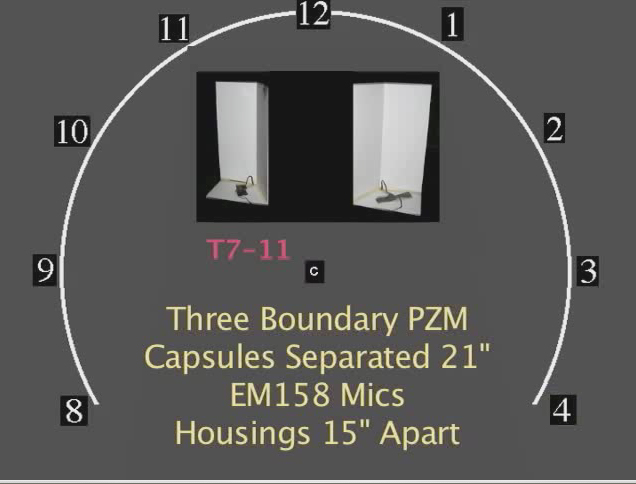
(Test10-11 ->)
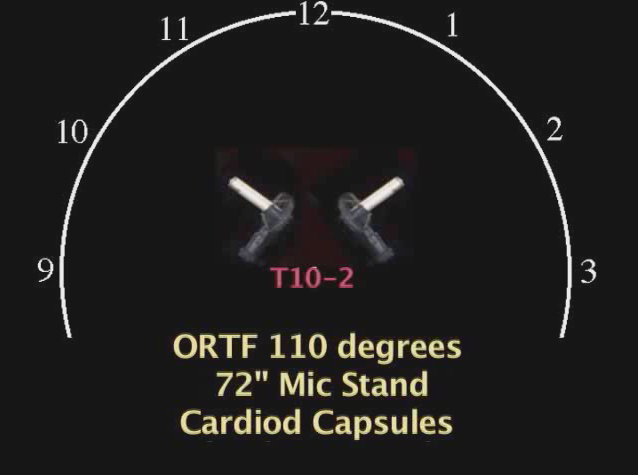 (<- Test10-02)
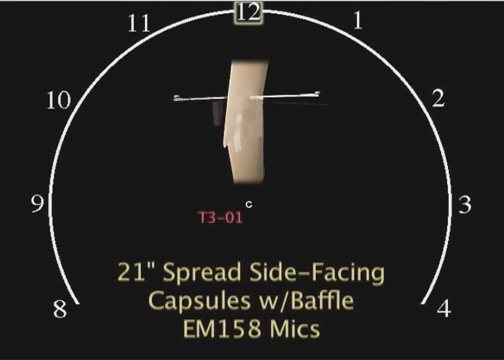 (Test03-01 ->)
Mike Jorgenson
So after going through the sound tests I have found 4 favorite recordings actually. They are test 3, station 1, test 8, station 3, test 10, station 2 and 11. I found that all of these tests had good localization to my ear with about equal spacing (distance-wise) between strikes. However, I found that the test3-01 rig had a much better sense of the depth of the space than the other three, followed next by test8-03 and then followed equally by test10-02 and test10-11. In fact to my ear the last two mentioned have very little depth to them and it is hard to tell what kind of space you are in. This first movie is the 2 o'clock position strike of these tests so that you can compare the distance they are felt to be at. However, despite their depth problems they also had good clear sounds, better so than the test3-01 rig and the test8-03 rig. Test3-01 tended to blend in more with the background noise, followed by test08-03 and then about equally with the remaining two. This second movie is the 12 o'clock position of each test, the one I figured would come through the clearest on each rig. Through this test you can also tell the different noise ratios of the rigs, although this could be a result of equalizing the levels. However it would seem that test03-01 has the lowest noise level, followed by test08-03 and then the remaining two about equally. However, because of all these factors I would say that test3-01 has the best sense of the architecture and is in general my favorite. To me localization and depth plays most importantly followed closely by quality. I've thrown up some pictures of the rigs for reference. Unfortunately the file of the complete tests compared to each other is about 20 mb so I don't have that up here.
Monday, December 11, 2006
Andy Chaney, Pieper DIY Post
Note: All sounds have been slowed down to 5% of their original speed.
Test 3, Station 7

Recording (click on "download full URL" under "file properties)
I chose this test because of the feeling that you were in a cement room of some type when listening to this. The sound felt very enclosed and specific, very much unlike the Sheboyghan Marsh recordings. The sound quality of this clip created a strong sense of the small-ish physical space of the room. It’s almost as if you can feel the distance that the “gong” (when slowed) sound travels across the Pieper factory to the microphone receptor. The space feels open, yet contained, as you can generally feel the sound travel to a certain distance and its aftermath, but it doesn’t make the space feel “too” open, as if you were standing outside. The space still feels contained to a degree, almost claustrophobic. As well as that, the microphone placement on the rig seems apparent to the listener during this recording, as the gongs generally feel as if they are being recorded about 6 inches apart, much the same distance as the human ear. It would be interesting to try a longer version of this rig, with say, a 13’’ difference, but still maintaining the boundary types, and not using a dowell. I’m not 100% sure about the 3’’ inch inset, I didn’t notice too much difference between the two different insets, but the spatiality of the microphones gives it an odd, haunting feeling, especially when the recording is slowed down this far.
Test 5, Station 2

Recording
This recording stood out to me because of the odd feeling of having 360 degrees of sound hitting the microphones. It felt almost TOO omni-directional, and this was odd because I didn’t really notice the placement of the Styrofoam head that should’ve acted somewhat as a boundary. Perhaps this was a result of slowing the recording down. This recording is much different from the first one. The lack of a boundary on the head similar to test 3 gave it a more “open” feeling. As if the microphones were picking up a more “natural” sound. You can notice some sounds from the building that feel as if they are behind, or to the side of the rig, instead of having them feel as if they are coming in a certain direction. The “gongs” resonate a little differently to my ears in this recording too, perhaps it was just the different way that the microphones were made, or perhaps they were placed differently from the boundary rig in test three, but this feels as if they are making an entirely different type of “gong” sound to my ears. Also, notice the sustained and trembling sort of feel that this rig has during the last several “gongs”. It feels as if it is capturing sounds from the “gongs” that are more towards the sides? The walls? Like there are more parts of the sound that are reaching the microphone than there were in Test 3.
Test 6, Station 14

Recording
The sound feels more “channeled” during this recording. I would be interested in seeing many different tests with the insets and angles that the rig experimented with here. This rig, like test 5, feels like it sustains differently than the other one did. The space of the room seems to be well-captured here, and the slowed down nature of the recording gives an odd feeling of the sound traveling “through” the microphones. The latter parts of the “gongs” feel as if they are being held by the rig for the microphone, after the initial and loud “gong” had past by, and the remaining sounds feel like they are “vibrating” off the space of the rig in dissonance. It’s hard to describe, but it seems to be capturing the ‘wobbly’ parts of the ‘gongs’ very well. It really feels as if each “O’Clock” are coming from a certain spatiality of the area, and there seems to be less feel towards what is behind the microphones. This acts well in creating the feeling that the room is far larger than it really was. Compare this towards the observation I made about test 3. Test 3 made the room seem smaller, and this one somehow made the room seem larger, yet it was still a boundary rig. All of the sounds feel like they are in front of the microphone, and held into a certain section of the space that they’re being recorded from. They feel very frontal, almost like you can visualize the section right in front of you that these sounds are coming from, both to the right and to the left.
Test 3, Station 7
Recording (click on "download full URL" under "file properties)
I chose this test because of the feeling that you were in a cement room of some type when listening to this. The sound felt very enclosed and specific, very much unlike the Sheboyghan Marsh recordings. The sound quality of this clip created a strong sense of the small-ish physical space of the room. It’s almost as if you can feel the distance that the “gong” (when slowed) sound travels across the Pieper factory to the microphone receptor. The space feels open, yet contained, as you can generally feel the sound travel to a certain distance and its aftermath, but it doesn’t make the space feel “too” open, as if you were standing outside. The space still feels contained to a degree, almost claustrophobic. As well as that, the microphone placement on the rig seems apparent to the listener during this recording, as the gongs generally feel as if they are being recorded about 6 inches apart, much the same distance as the human ear. It would be interesting to try a longer version of this rig, with say, a 13’’ difference, but still maintaining the boundary types, and not using a dowell. I’m not 100% sure about the 3’’ inch inset, I didn’t notice too much difference between the two different insets, but the spatiality of the microphones gives it an odd, haunting feeling, especially when the recording is slowed down this far.
Test 5, Station 2
Recording
This recording stood out to me because of the odd feeling of having 360 degrees of sound hitting the microphones. It felt almost TOO omni-directional, and this was odd because I didn’t really notice the placement of the Styrofoam head that should’ve acted somewhat as a boundary. Perhaps this was a result of slowing the recording down. This recording is much different from the first one. The lack of a boundary on the head similar to test 3 gave it a more “open” feeling. As if the microphones were picking up a more “natural” sound. You can notice some sounds from the building that feel as if they are behind, or to the side of the rig, instead of having them feel as if they are coming in a certain direction. The “gongs” resonate a little differently to my ears in this recording too, perhaps it was just the different way that the microphones were made, or perhaps they were placed differently from the boundary rig in test three, but this feels as if they are making an entirely different type of “gong” sound to my ears. Also, notice the sustained and trembling sort of feel that this rig has during the last several “gongs”. It feels as if it is capturing sounds from the “gongs” that are more towards the sides? The walls? Like there are more parts of the sound that are reaching the microphone than there were in Test 3.
Test 6, Station 14
Recording
The sound feels more “channeled” during this recording. I would be interested in seeing many different tests with the insets and angles that the rig experimented with here. This rig, like test 5, feels like it sustains differently than the other one did. The space of the room seems to be well-captured here, and the slowed down nature of the recording gives an odd feeling of the sound traveling “through” the microphones. The latter parts of the “gongs” feel as if they are being held by the rig for the microphone, after the initial and loud “gong” had past by, and the remaining sounds feel like they are “vibrating” off the space of the rig in dissonance. It’s hard to describe, but it seems to be capturing the ‘wobbly’ parts of the ‘gongs’ very well. It really feels as if each “O’Clock” are coming from a certain spatiality of the area, and there seems to be less feel towards what is behind the microphones. This acts well in creating the feeling that the room is far larger than it really was. Compare this towards the observation I made about test 3. Test 3 made the room seem smaller, and this one somehow made the room seem larger, yet it was still a boundary rig. All of the sounds feel like they are in front of the microphone, and held into a certain section of the space that they’re being recorded from. They feel very frontal, almost like you can visualize the section right in front of you that these sounds are coming from, both to the right and to the left.
Wednesday, December 06, 2006
Blind leading the Blind
If I were to lose my sense of smell, my other four senses: vision, touch, sight, and sound would kick in to help my body adapt to the need of my environment. This happens with any of the senses. You lose one; and the team is there to back you up. Since I am not the sound afficianado that I might like to be, I will be giving up my sense of sight in order to listen better. (Don't worry- nothing permanent, it's only for a bit.) With all of the homemade rigs and mics that we made for the Pieper Warehouse testing, I've decided to compare 3 rigs within the same test, and the same ding; without my sight. Of course, it's a given that I will hear that awful nail strike many times, but my actual goal is to be able to distinguish between each rig with the background sounds.
I have chosen Test #8, ding station 2. I have chosen this ding mostly because of the background sounds that happen. After the strike, there is some shuffling around. I want to explore this sound more.
Now, I have admitted to the world that I am not the sound expert I might one day be, and for that- I am using my own rig, a Triple Boundry Dish made out of cardboard with an EM158 attached to it. If I can't figure out my own rig, I might be in trouble.


My next rig of distinction choice is Josh's. In my previous post, I indicated that I enjoyed how clear his sounds compared to some of the other rigs made.


And lastly, Holly's Triple Boundy Rig. I might be committing sound suicide by comparing two triple boundry rigs!


So you know what I'm listening to, here is the quicktime movie I made. Grab a cup of tea, and sit back and listen to some dings. I've looped it quite a few times so maybe you can get lost and do some blind testing yourself.
In order to blindly listen, I've put down the headphones, covered the quicktime window with another window and let it play through a few times- sort of like scrambling all the cards in Go Fish. I want to describe the quality of the noises with each ding and after I've made my coments I'm going to put a rig to each noise. I'm crossing my fingers!!!
Right away, I can tell which rig is mine without much trouble. Station 9 sounds muffled and underwater compared to the other two dings. The noises that happen right after the ding are barely audible compared to the other two noises. I would account this to maybe the triple boundy, however Holly has a triple boundry. Next I would try to account this to it being on the floor, but once again, so is Holly's. I might chalk up the muffled drone to the factory noises that surround the warehouse.
I thought my biggest problem would be distinguishing between my rig and Holly's rig because they are similar in make if nothing else. However- since I've already chosen mine as being the muffled one, I'm left to contend with Holly and Josh's. As with the background noise in my rig, one of them is muffled, but the other has a very distinct noise (like that of wood creaking). This rig also has the loudest ding, probably because of it's position to the nails. I know that Josh's position was a little closer to me than Holly, and I vaguely remember Holly's rig being closer to the two mark than either of our rigs. After looking at the spread sheet, I notice that Holly's rig is also on the back wall of a wood warehouse. So, the loudest ding, and the wood must be a result of Holly's rig.
The vast sound difference of the two triple boundry rigs probably have something to do with the idea that Holly's microphones were always a constant distance from eachother. My two triple boundry dishes were spread apart about 25 inches from eachother. This most likely leads to some serious distortion of the stereo sound and image.
After listening to the same three dings for the past half an hour, the background noise in all of them must be the wood creaking (if that's what it is). Although, given mine and Josh's rig alone I would have had no clue as to what the sound could be.
I have chosen Test #8, ding station 2. I have chosen this ding mostly because of the background sounds that happen. After the strike, there is some shuffling around. I want to explore this sound more.
Now, I have admitted to the world that I am not the sound expert I might one day be, and for that- I am using my own rig, a Triple Boundry Dish made out of cardboard with an EM158 attached to it. If I can't figure out my own rig, I might be in trouble.
My next rig of distinction choice is Josh's. In my previous post, I indicated that I enjoyed how clear his sounds compared to some of the other rigs made.
And lastly, Holly's Triple Boundy Rig. I might be committing sound suicide by comparing two triple boundry rigs!
So you know what I'm listening to, here is the quicktime movie I made. Grab a cup of tea, and sit back and listen to some dings. I've looped it quite a few times so maybe you can get lost and do some blind testing yourself.
In order to blindly listen, I've put down the headphones, covered the quicktime window with another window and let it play through a few times- sort of like scrambling all the cards in Go Fish. I want to describe the quality of the noises with each ding and after I've made my coments I'm going to put a rig to each noise. I'm crossing my fingers!!!
Right away, I can tell which rig is mine without much trouble. Station 9 sounds muffled and underwater compared to the other two dings. The noises that happen right after the ding are barely audible compared to the other two noises. I would account this to maybe the triple boundy, however Holly has a triple boundry. Next I would try to account this to it being on the floor, but once again, so is Holly's. I might chalk up the muffled drone to the factory noises that surround the warehouse.
I thought my biggest problem would be distinguishing between my rig and Holly's rig because they are similar in make if nothing else. However- since I've already chosen mine as being the muffled one, I'm left to contend with Holly and Josh's. As with the background noise in my rig, one of them is muffled, but the other has a very distinct noise (like that of wood creaking). This rig also has the loudest ding, probably because of it's position to the nails. I know that Josh's position was a little closer to me than Holly, and I vaguely remember Holly's rig being closer to the two mark than either of our rigs. After looking at the spread sheet, I notice that Holly's rig is also on the back wall of a wood warehouse. So, the loudest ding, and the wood must be a result of Holly's rig.
The vast sound difference of the two triple boundry rigs probably have something to do with the idea that Holly's microphones were always a constant distance from eachother. My two triple boundry dishes were spread apart about 25 inches from eachother. This most likely leads to some serious distortion of the stereo sound and image.
After listening to the same three dings for the past half an hour, the background noise in all of them must be the wood creaking (if that's what it is). Although, given mine and Josh's rig alone I would have had no clue as to what the sound could be.
Sunday, October 29, 2006
Lamm "L2" Triple Boundary PZM Array

After I finished my PZM capsule "pick-ups," it only took me an half hour to build the Lamm L2 unit out of 1/4" think foam core. Two 20" X30" sheets were sufficient. The slowest part was figuring out the layout for the base. The L2 definitely produces a curious stereo image. Localization is quite good. As described in the Crown Application Guide, mounting the DIY PZM capsules on a boundary smaller than 4 ft. by 4 ft. does attenuate some low frequencies. You can take a listen/look at some files and sonograms I assembled here. Rob D.
Subscribe to:
Posts (Atom)